20th Prime Minister of Australia
William McMahon
Liberal prime minister of Australia, 1971–1972.
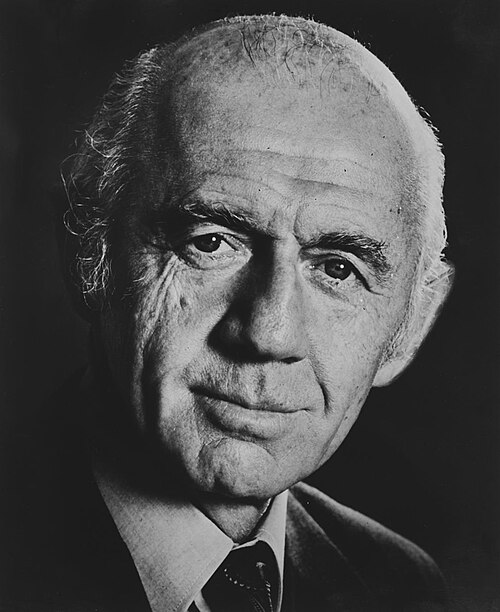
Biography
William McMahon was born in Sydney on 23 February 1908. His father was a lawyer and businessman, and both his parents died while he was young, after which he was raised largely by relatives. He was educated at Sydney Grammar School and studied law at the University of Sydney, later also completing an economics degree after the Second World War.
McMahon practised as a solicitor with a leading Sydney firm before the war. He served in the Australian Army during the Second World War, reaching the rank of major, though his hearing difficulties kept him from front-line service. After the war he travelled in Europe and returned to study economics before turning to politics with the newly formed Liberal Party.
He was elected to the House of Representatives for the Sydney seat of Lowe at the 1949 election, which brought the Menzies Government to office, and held the seat until 1982. McMahon proved an industrious and ambitious minister. He was appointed Minister for the Navy and Minister for Air in 1951, and later held the portfolios of Social Services, Primary Industry, and Labour and National Service, the last from 1958 to 1966. Under Harold Holt he became Treasurer in 1966 and was elected deputy leader of the Liberal Party. He was widely seen as Holt's likely successor, but after Holt's death in December 1967 the Country Party leader John McEwen made clear that his party would not serve under McMahon, and John Gorton won the leadership instead. McMahon moved to External Affairs in 1969.
Tensions within the Liberal Party under Gorton came to a head in March 1971, when a party-room confidence vote was tied and Gorton chose to resign. McMahon defeated Billy Snedden for the leadership and was sworn in as Prime Minister on 10 March 1971. His government continued the withdrawal of Australian forces from Vietnam, with most combat troops returned by early 1972, and transferred payroll tax to the states. It was caught off guard by the shift in United States policy towards China in July 1971, shortly after McMahon had criticised Whitlam's visit to Beijing. In January 1972 his Australia Day statement rejecting a general form of Aboriginal land rights prompted activists to establish the Aboriginal Tent Embassy outside Parliament House in Canberra.
McMahon faced an Opposition that appeared increasingly confident and a government that had been in office for more than two decades. At the election of 2 December 1972 the Coalition was defeated by Labor under Gough Whitlam, ending McMahon's term after 21 months. He resigned the Liberal leadership soon afterwards and was succeeded by Billy Snedden.
McMahon remained in Parliament as a backbencher for nearly another decade, retiring in 1982. He was appointed a Knight Grand Cross of the Order of St Michael and St George in 1977. He married Sonia Hopkins in 1965, and they had three children. Sir William McMahon died in Sydney on 31 March 1988.
Public debt while in office
- Debt to GDP, taking office
- 34.9% (end-1970)
- Leaving office
- 30.7% (end-1972)
- Change
- -4.2 points of GDP
- In dollars (at the time)
- $12.9 billion → $13.7 billion
Gross public debt of all levels of government as a share of GDP at the year-end nearest each change of prime minister (IMF). Compare every prime minister.