28th Prime Minister of Australia
Tony Abbott
Liberal prime minister of Australia, 2013–2015.
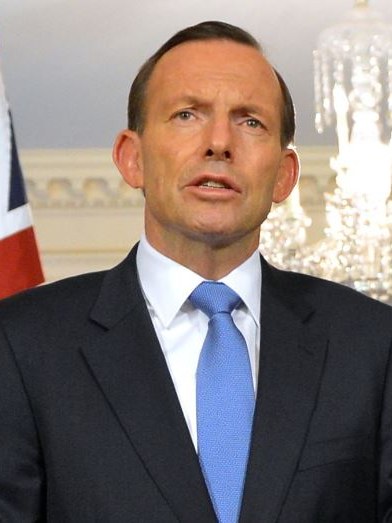
Biography
Anthony John Abbott was born on 4 November 1957 in London to an English father and Australian mother, and moved with his family to Sydney in 1960. He was educated at St Ignatius' College, Riverview, and the University of Sydney, where he graduated in economics and law and was prominent in conservative student politics. As a Rhodes Scholar he studied politics, philosophy and economics at The Queen's College, Oxford, where he also boxed for the university.
On returning to Australia Abbott spent several years studying for the Catholic priesthood at St Patrick's Seminary, Manly, before leaving to pursue journalism, writing for The Bulletin and The Australian. He also worked briefly as a plant manager at a concrete company. He then became press secretary to Liberal leader John Hewson and in 1993–1994 served as the first executive director of Australians for Constitutional Monarchy, campaigning against proposals for a republic.
Abbott entered the House of Representatives in March 1994 after winning a by-election for the northern Sydney seat of Warringah. Following the election of the Howard government he held a series of portfolios, serving as Minister for Employment Services, Minister for Employment and Workplace Relations, and Minister for Health and Ageing from 2003 to 2007. He was also Leader of the House for much of the government's term.
In opposition after 2007 Abbott held shadow portfolios before challenging Malcolm Turnbull over the Liberal Party's approach to the Rudd government's emissions trading scheme. On 1 December 2009 he won the leadership by one vote. At the 2010 election the Coalition came close to winning office, producing a hung parliament in which Labor retained government with crossbench support. Abbott then led a sustained campaign against the Gillard government's carbon pricing scheme and its border protection policies.
The Coalition won the election of 7 September 2013, and Abbott was sworn in as Australia's 28th Prime Minister on 18 September 2013. His government repealed the carbon pricing mechanism in 2014 and the Minerals Resource Rent Tax, implemented Operation Sovereign Borders, and concluded free trade agreements with Japan, South Korea and China. It established the Medical Research Future Fund and committed Australian forces to operations against the Islamic State group in Iraq. Its first budget in 2014, which contained significant spending cuts and proposals such as a Medicare co-payment, met strong resistance in the Senate and in public opinion. Abbott also led Australia's response to the downing of Malaysia Airlines Flight MH17 in July 2014.
Persistently poor opinion polling and controversy over decisions such as the reintroduction of knighthoods led to an unsuccessful spill motion against Abbott in February 2015. On 14 September 2015 he lost the Liberal leadership to Malcolm Turnbull by 54 votes to 44 and left office the following day. He remained in Parliament as a backbencher until the 2019 election, when he lost Warringah to independent Zali Steggall. He has since served as an adviser to the United Kingdom Board of Trade and been active in conservative think tanks and commentary. He is married to Margie Abbott, with whom he has three daughters.
Public debt while in office
- Debt to GDP, taking office
- 30.5% (end-2013)
- Leaving office
- 37.7% (end-2015)
- Change
- +7.2 points of GDP
- In dollars (at the time)
- $470.8 billion → $614.8 billion
Gross public debt of all levels of government as a share of GDP at the year-end nearest each change of prime minister (IMF). Compare every prime minister.