8th Prime Minister of Australia
Stanley Bruce
Nationalist prime minister of Australia, 1923–1929.
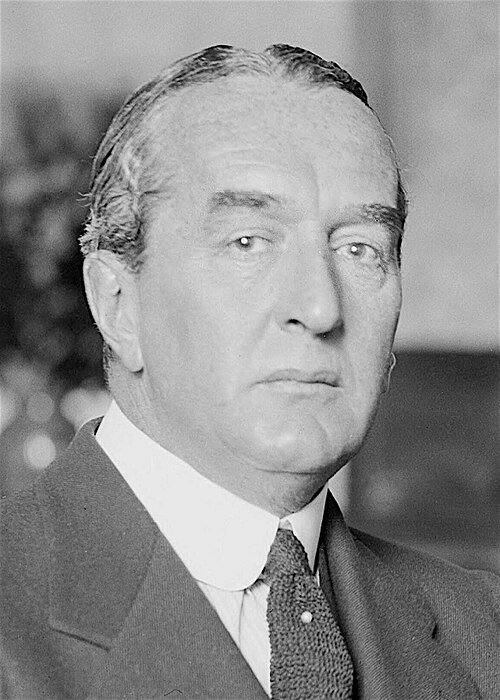
Biography
Stanley Melbourne Bruce was born on 15 April 1883 in St Kilda, Melbourne, the youngest child of a prosperous Scottish-born merchant whose firm imported soft goods. He was educated at Melbourne Church of England Grammar School and, after his father's death, at Trinity Hall, Cambridge, where he was a noted rower. He was called to the English bar and divided his time between legal work in London and the family business, which he came to chair.
When the First World War began, Bruce obtained a commission in the British Army and served with the Worcestershire Regiment and later the Royal Fusiliers at Gallipoli, where he was wounded. He was awarded the Military Cross and the French Croix de Guerre. Invalided out of the army, he returned to Australia in 1917 and became a public speaker in support of recruitment.
Bruce entered federal politics at a by-election for the Victorian seat of Flinders in May 1918, representing the Nationalist Party. He made an impression as a businesslike newcomer and in 1921 was appointed Treasurer in the Hughes government. When the Nationalists lost their majority at the 1922 election, the Country Party under Earle Page refused to form a coalition while Billy Hughes remained leader. Hughes resigned, and Bruce became prime minister on 9 February 1923 at the head of a Nationalist–Country Party coalition, with Page as Treasurer.
Bruce's government pursued national development under the slogan of 'men, money and markets', promoting assisted British migration, overseas borrowing and the expansion of primary industries. It established the Development and Migration Commission and the Council for Scientific and Industrial Research, and negotiated the Financial Agreement of 1927, which placed Commonwealth and state borrowing under the Australian Loan Council and was confirmed by referendum in 1928. In 1927 the Parliament moved from Melbourne to the provisional Parliament House in Canberra. The coalition won comfortable victories at the 1925 and 1928 elections.
Industrial relations dominated the government's later years. Following prolonged disputes on the waterfront, in the coalfields and elsewhere, Bruce proposed in 1929 to withdraw the Commonwealth from most of the field of industrial arbitration, leaving it to the states. Hughes and several other government members voted against the Maritime Industries Bill, the government lost a key vote in September 1929 and Bruce called an election. At the poll of 12 October 1929 the government was heavily defeated and Bruce lost Flinders, the first sitting prime minister to lose his own seat.
Bruce regained Flinders in 1931 and served in the Lyons government as an assistant minister, representing Australia at the 1932 Ottawa conference. In 1933 he became High Commissioner in London, a post he held until 1945. He was also a prominent figure at the League of Nations, presiding over its Council in 1936 and chairing a committee whose recommendations on economic and social cooperation anticipated later international bodies. After the war he chaired the council of the Food and Agriculture Organization.
In 1947 Bruce was created Viscount Bruce of Melbourne, becoming the first Australian to sit in the House of Lords. He served as the first Chancellor of the Australian National University from 1951 to 1961. He died in London on 25 August 1967, and in accordance with his wishes his ashes were scattered over Lake Burley Griffin in Canberra.
Public debt while in office
- Debt to GDP, taking office
- 63.4% (end-1922)
- Leaving office
- 63.8% (end-1929)
- Change
- +0.4 points of GDP
Gross public debt of all levels of government as a share of GDP at the year-end nearest each change of prime minister (IMF). Compare every prime minister.