12th Prime Minister of Australia
Robert Menzies
Liberal prime minister of Australia, 1939–1941 and 1949–1966.
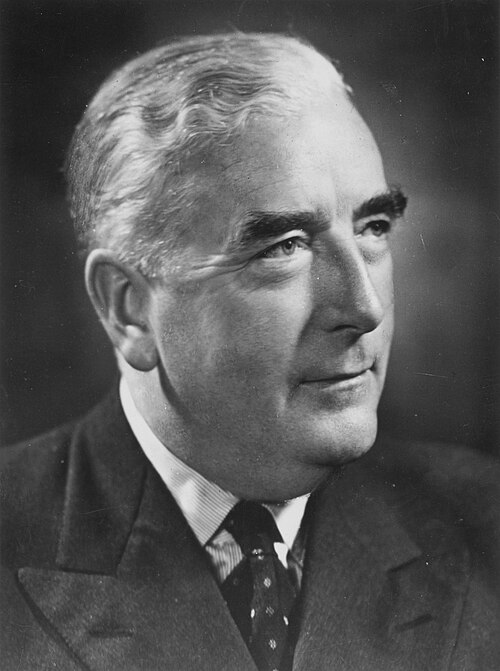
Biography
Robert Gordon Menzies was born on 20 December 1894 at Jeparit, a small town in the Wimmera district of Victoria, where his father kept a general store and later served in the Victorian Parliament. A scholarship student, he attended schools in Ballarat and Melbourne, including Wesley College, before studying law at the University of Melbourne, where he graduated with first-class honours. He did not enlist during the First World War, a decision that was later used against him by political opponents. He married Pattie Leckie in 1920.
Menzies was admitted to the Victorian Bar in 1918 and quickly became a leading constitutional barrister, notably appearing in the 1920 Engineers' Case that broadened the interpretation of Commonwealth legislative power. He entered the Victorian Legislative Council in 1928 and moved to the Legislative Assembly in 1929, serving as Attorney-General and Deputy Premier. In 1934 he won the federal seat of Kooyong for the United Australia Party and was immediately appointed Attorney-General in the Lyons Government. His use of legislation against waterside workers who refused to load pig iron for Japan in 1938 earned him the nickname 'Pig Iron Bob'.
Following the death of Joseph Lyons in April 1939 and a brief caretaker period under Earle Page, Menzies was elected UAP leader and sworn in as Prime Minister on 26 April 1939. On 3 September 1939 he announced that Australia was at war with Germany. His government at first lacked Country Party support, but a coalition was formed in 1940. The Canberra air disaster of August 1940 killed three senior ministers, and the election of September 1940 left the government dependent on two independents. Menzies spent several months in Britain in 1941, and on his return faced mounting criticism within his own ranks. He resigned on 29 August 1941 and was succeeded by Arthur Fadden.
In opposition, Menzies drew together a range of non-Labor organisations to form the Liberal Party of Australia, founded at conferences in Canberra and Albury in 1944 and formally established in 1945. His 1942 radio address 'The Forgotten People' set out the middle-class values he sought to represent. The Liberal–Country Coalition won the election of 10 December 1949, campaigning against bank nationalisation and petrol rationing, and Menzies was sworn in again on 19 December 1949. He went on to win the elections of 1951, 1954, 1955, 1958, 1961 and 1963, becoming Australia's longest-serving prime minister.
Menzies' second government attempted to ban the Communist Party of Australia; the High Court struck down the legislation in 1951 and a referendum to grant the necessary power was narrowly defeated later that year. The government signed the ANZUS Treaty with the United States and New Zealand in 1951, joined the South-East Asia Treaty Organization in 1954, participated in the Colombo Plan and committed forces to Korea, Malaya and, from 1965, Vietnam, supported by the national service scheme reintroduced in 1964. The defection of Soviet diplomat Vladimir Petrov in 1954 and the subsequent Labor split shaped politics for a generation. Domestically, the period saw sustained economic growth, high immigration, the 1957 trade agreement with Japan, greatly expanded Commonwealth funding for universities, the beginning of federal aid to non-government schools and the development of Canberra under the National Capital Development Commission. The government also extended voting rights in federal elections to all Aboriginal people in 1962, while the White Australia policy largely remained in place during his tenure.
Menzies retired as Prime Minister on 26 January 1966 and left Parliament shortly afterwards. He was appointed a Knight of the Order of the Thistle in 1963 and served as Lord Warden of the Cinque Ports, an honorary British office, and as Chancellor of the University of Melbourne. He wrote memoirs and lectured in the United States. Strokes in the early 1970s limited his activities in later life. Sir Robert Menzies died in Melbourne on 15 May 1978 and was given a state funeral.
Public debt while in office
1939–1941
- Debt to GDP, taking office
- 68.7% (end-1938)
- Leaving office
- 66.5% (end-1941)
- Change
- -2.2 points of GDP
1949–1966
- Debt to GDP, taking office
- 65.4% (end-1949)
- Leaving office
- 43.7% (end-1965)
- Change
- -21.7 points of GDP
Gross public debt of all levels of government as a share of GDP at the year-end nearest each change of prime minister (IMF). Compare every prime minister.