29th Prime Minister of Australia
Malcolm Turnbull
Liberal prime minister of Australia, 2015–2018.
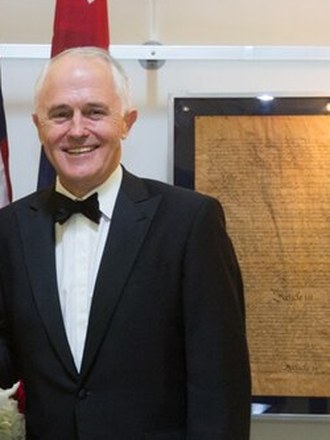
Biography
Malcolm Bligh Turnbull was born on 24 October 1954 in Sydney. He was largely raised by his father, Bruce, after his mother left the family when he was young. He attended Sydney Grammar School and then the University of Sydney, where he studied arts and law and was involved in student journalism. Awarded a Rhodes Scholarship, he completed a Bachelor of Civil Law at Oxford.
Turnbull worked as a political journalist while studying and then practised as a barrister and in-house counsel. He came to national and international attention in 1986–1987 when he successfully defended the publication in Australia of Spycatcher, the memoir of a former British intelligence officer, against the British government. He later moved into business, co-founding an investment banking firm, serving as chairman of the internet provider OzEmail and becoming a partner and managing director in Australia of Goldman Sachs. From 1993 to 2000 he chaired the Australian Republican Movement, leading the case for a republic at the 1999 referendum, which was defeated.
Turnbull was elected to the House of Representatives for the eastern Sydney seat of Wentworth at the 2004 federal election. He served as a parliamentary secretary and in January 2007 joined the Howard cabinet as Minister for the Environment and Water Resources. After the Coalition's defeat later that year he became shadow treasurer, and in September 2008 he was elected Leader of the Opposition. His support for negotiating with the Rudd government over its emissions trading scheme divided the Liberal Party, and in December 2009 he lost the leadership to Tony Abbott by a single vote.
Remaining in Parliament, Turnbull returned to the frontbench as shadow minister for communications and, after the 2013 election, became Minister for Communications, responsible for redesigning the National Broadband Network around a mix of technologies. On 14 September 2015 he challenged Abbott for the Liberal leadership and won by 54 votes to 44. He was sworn in as Australia's 29th Prime Minister the following day.
Turnbull called a double dissolution election for 2 July 2016, at which the Coalition was returned with a one-seat majority in the House of Representatives. His government conducted a national postal survey on same-sex marriage in 2017, after which Parliament legislated for marriage equality in December that year. It introduced a revised needs-based school funding model, announced the Snowy 2.0 pumped hydro expansion, legislated tax cuts for small and medium businesses, created the Home Affairs portfolio and passed new laws against foreign interference. The government was also affected by a series of disqualifications of parliamentarians under section 44 of the Constitution over dual citizenship, and by internal disagreement over energy policy, notably the proposed National Energy Guarantee.
In August 2018 Turnbull survived a leadership challenge from Peter Dutton, but days later a majority of Liberal members supported a second spill, and he did not stand in the ballot that Scott Morrison won. Turnbull left office on 24 August 2018 and resigned from Parliament shortly afterwards; the resulting Wentworth by-election was won by independent Kerryn Phelps. He published a memoir, A Bigger Picture, in 2020, and has since been involved in clean energy and climate advocacy, including serving as president of the International Hydropower Association. He is married to Lucy Turnbull, a former Lord Mayor of Sydney, and they have two children.
Public debt while in office
- Debt to GDP, taking office
- 37.7% (end-2015)
- Leaving office
- 41.8% (end-2018)
- Change
- +4.1 points of GDP
- In dollars (at the time)
- $614.8 billion → $772.9 billion
Gross public debt of all levels of government as a share of GDP at the year-end nearest each change of prime minister (IMF). Compare every prime minister.