22nd Prime Minister of Australia
Malcolm Fraser
Liberal prime minister of Australia, 1975–1983.
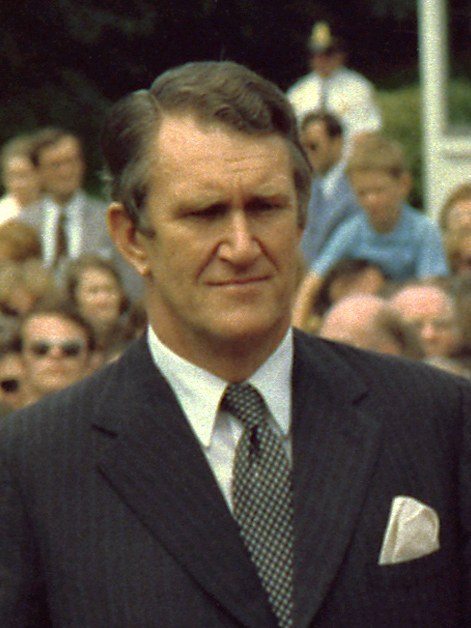
Biography
John Malcolm Fraser was born on 21 May 1930 in Melbourne into a pastoral family and spent his childhood on a property in the Riverina district of New South Wales. He was educated at Melbourne Grammar School and then at Magdalen College, Oxford, where he studied philosophy, politics and economics, graduating in 1952.
On returning to Australia Fraser took over management of Nareen, the family's grazing property in western Victoria, and became involved in the Liberal Party. He stood for the seat of Wannon in 1954 and lost by a very narrow margin of votes.
Fraser won Wannon at the 1955 election, becoming one of the youngest members of the House of Representatives. After a decade on the backbench he was appointed Minister for the Army in 1966, and later served as Minister for Education and Science and Minister for Defence. In March 1971 he resigned from cabinet with a statement criticising Prime Minister John Gorton, which precipitated Gorton's fall. He returned to the ministry under William McMahon as Minister for Education and Science until the Coalition's defeat in 1972.
In March 1975 Fraser defeated Billy Snedden for the Liberal leadership. Later that year the opposition used its Senate numbers to defer the Whitlam government's budget bills, creating a constitutional crisis. On 11 November 1975 the Governor-General, Sir John Kerr, dismissed Whitlam and commissioned Fraser as caretaker Prime Minister, the 22nd to hold the office, on condition that he call an election. The Coalition won the election of 13 December 1975 with the largest majority in federal history to that time, and was returned again in 1977 and 1980.
Fraser's government pursued spending restraint and changes to the Medibank health scheme, while also implementing reforms with lasting effect. It passed the Aboriginal Land Rights (Northern Territory) Act 1976, accepted large numbers of Indochinese refugees, established the Special Broadcasting Service, and expanded administrative law through the Ombudsman, the Administrative Appeals Tribunal and the Freedom of Information Act 1982. It also created the Human Rights Commission. Internationally, Fraser was a strong opponent of apartheid, supported the Gleneagles Agreement against sporting contacts with South Africa, and played a role in the Commonwealth's efforts to bring about majority rule in Zimbabwe.
Fraser called an early election for 5 March 1983, which the Coalition lost to Labor under Bob Hawke. He resigned from Parliament soon afterwards. He went on to co-chair the Commonwealth Eminent Persons Group on South Africa in 1985–1986, was founding chair of the aid organisation CARE Australia, and became a prominent advocate on human rights, refugees and Australian foreign policy, publishing Dangerous Allies in 2014. He resigned his Liberal Party membership in late 2009. He married Tamara (Tamie) Beggs in 1956, and they had four children. Fraser died in Melbourne on 20 March 2015, aged 84.
Public debt while in office
- Debt to GDP, taking office
- 23.6% (end-1975)
- Leaving office
- 16.8% (end-1982)
- Change
- -6.8 points of GDP
- In dollars (at the time)
- $16.8 billion → $29.6 billion
Gross public debt of all levels of government as a share of GDP at the year-end nearest each change of prime minister (IMF). Compare every prime minister.