26th Prime Minister of Australia
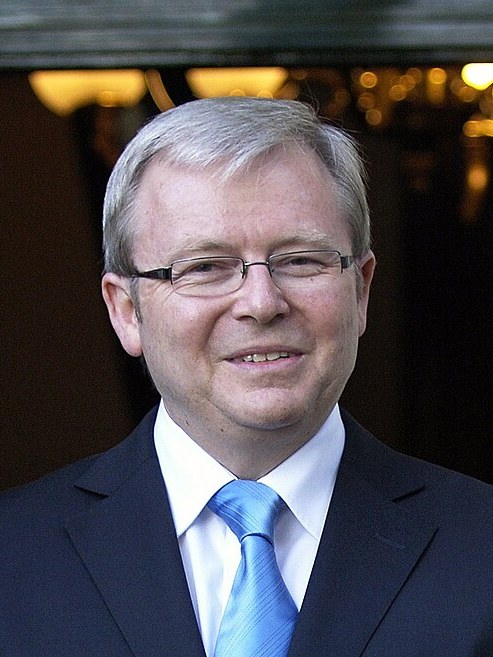
Kevin Rudd
Labor prime minister of Australia, 2007–2010 and 2013.
Biography
Kevin Michael Rudd was born on 21 September 1957 in Nambour, Queensland, and grew up on a dairy farm near Eumundi on the Sunshine Coast. His father died when he was eleven, after which the family left the farm. He attended Marist College Ashgrove and Nambour State High School, where he was dux. He studied at the Australian National University, graduating with first-class honours in Asian studies with a focus on Chinese language and history.
Rudd joined the Department of Foreign Affairs in 1981 and served in diplomatic postings in Stockholm and Beijing. In 1988 he became chief of staff to Queensland Opposition Leader Wayne Goss, and after Goss won government in 1989 he was appointed director-general of the Queensland Office of the Cabinet, a senior public service role. He later worked as a China consultant with an accounting firm.
After an unsuccessful attempt in 1996, Rudd was elected to the House of Representatives for the Brisbane seat of Griffith in 1998. He became shadow minister for foreign affairs in 2001 and built a national profile through media appearances. On 4 December 2006 he defeated Kim Beazley for the Labor leadership, with Julia Gillard as his deputy, and led the party to a decisive victory over the Howard government at the election of 24 November 2007. He was sworn in as Australia's 26th Prime Minister on 3 December 2007.
In his first term Rudd ratified the Kyoto Protocol and, on 13 February 2008, delivered a formal national apology to the Stolen Generations. His government replaced the WorkChoices industrial laws, responded to the global financial crisis with large economic stimulus packages including cash payments and school and housing construction, and Australia avoided a technical recession. It announced the National Broadband Network and promoted the G20 as the main forum for leaders' economic cooperation. However, its Carbon Pollution Reduction Scheme was twice rejected by the Senate, and its decision to defer the scheme, along with conflict with the mining industry over a proposed Resource Super Profits Tax, contributed to a sharp fall in support. Facing a challenge from Gillard, Rudd chose not to contest a ballot and left office on 24 June 2010.
Rudd was re-elected for Griffith in 2010 and served as Minister for Foreign Affairs in the Gillard government until February 2012, when he resigned and unsuccessfully challenged Gillard, losing by 71 votes to 31. On 26 June 2013 he defeated Gillard by 57 votes to 45 and was sworn in for a second time as Prime Minister on 27 June 2013. During this brief term he announced a regional resettlement arrangement with Papua New Guinea for asylum seekers arriving by boat and moved to replace the fixed carbon price with an emissions trading scheme. Labor lost the election of 7 September 2013.
Rudd resigned from Parliament in November 2013. He took up academic positions in the United States and became president of the Asia Society Policy Institute, and in 2016 sought nomination for the position of Secretary-General of the United Nations, though the Australian Government declined to nominate him. He was appointed Australian Ambassador to the United States by the Albanese government, taking up the post in 2023. He is married to Thérèse Rein, a businesswoman, and they have three children.
Public debt while in office
2007–2010
- Debt to GDP, taking office
- 9.7% (end-2007)
- Leaving office
- 16.6% (end-2009)
- Change
- +6.9 points of GDP
- In dollars (at the time)
- $105.8 billion → $210.1 billion
2013–2013
- Debt to GDP, taking office
- 27.5% (end-2012)
- Leaving office
- 30.5% (end-2013)
- Change
- +3 points of GDP
- In dollars (at the time)
- $414.1 billion → $470.8 billion
Gross public debt of all levels of government as a share of GDP at the year-end nearest each change of prime minister (IMF). Compare every prime minister.