27th Prime Minister of Australia
Julia Gillard
Labor prime minister of Australia, 2010–2013.
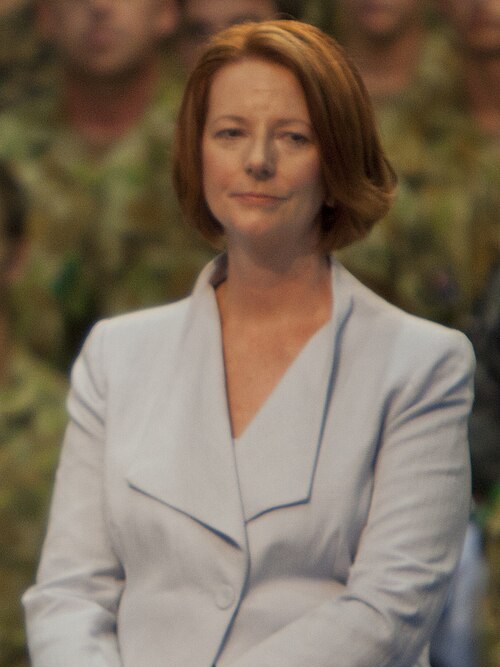
Biography
Julia Eileen Gillard was born on 29 September 1961 in Barry, Wales, and migrated with her family to Adelaide in 1966. She attended Mitcham Demonstration School and Unley High School before beginning arts and law studies at the University of Adelaide. She later moved to Melbourne, completing degrees in arts and law at the University of Melbourne, and in 1983 served as president of the Australian Union of Students.
Gillard joined the Melbourne law firm Slater and Gordon, specialising in industrial law, and became a partner in 1990. In 1996 she left legal practice to become chief of staff to John Brumby, then Leader of the Opposition in Victoria before seeking preselection for federal Parliament.
Gillard was elected to the House of Representatives for the western Melbourne seat of Lalor at the 1998 federal election. In opposition she held portfolios including population and immigration, reconciliation and Indigenous affairs, and health, and she developed a reputation as an effective parliamentary performer. In December 2006 she was elected deputy leader of the Labor Party alongside Kevin Rudd.
After Labor won the 2007 election Gillard became the first woman to serve as Deputy Prime Minister, and held the combined portfolio of Education, Employment and Workplace Relations, as well as Social Inclusion. She oversaw the replacement of the WorkChoices laws with the Fair Work Act 2009, the introduction of the My School website and national testing reporting, and the Building the Education Revolution school infrastructure program. On 24 June 2010, after Rudd declined to contest a leadership ballot, she was elected unopposed as Labor leader and sworn in as Australia's 27th Prime Minister and its first female prime minister.
Gillard called an election for 21 August 2010, which produced the first hung federal parliament since 1940. She formed a minority government with the support of the Australian Greens and independents. Her government legislated a carbon pricing mechanism that commenced on 1 July 2012, introduced the Minerals Resource Rent Tax, and established the National Disability Insurance Scheme. It legislated plain packaging of tobacco products, a world first, passed school funding reforms arising from the Gonski review, and established the Royal Commission into Institutional Responses to Child Sexual Abuse. A national paid parental leave scheme began in January 2011. In October 2012 her parliamentary speech on sexism and misogyny attracted wide international attention.
Gillard faced continued pressure over the leadership. She defeated Rudd in a ballot in February 2012 by 71 votes to 31, and no challenge eventuated in March 2013, but on 26 June 2013 she lost a caucus ballot to Rudd by 57 votes to 45 and left office the following day. She did not contest the 2013 election. In later years she chaired the Global Partnership for Education and the mental health organisation Beyond Blue, became inaugural chair of the Global Institute for Women's Leadership at King's College London, and in 2021 became chair of the Wellcome Trust. Her memoir, My Story, was published in 2014.
Public debt while in office
- Debt to GDP, taking office
- 16.6% (end-2009)
- Leaving office
- 27.5% (end-2012)
- Change
- +10.9 points of GDP
- In dollars (at the time)
- $210.1 billion → $414.1 billion
Gross public debt of all levels of government as a share of GDP at the year-end nearest each change of prime minister (IMF). Compare every prime minister.