10th Prime Minister of Australia
Joseph Lyons
United Australia prime minister of Australia, 1932–1939.
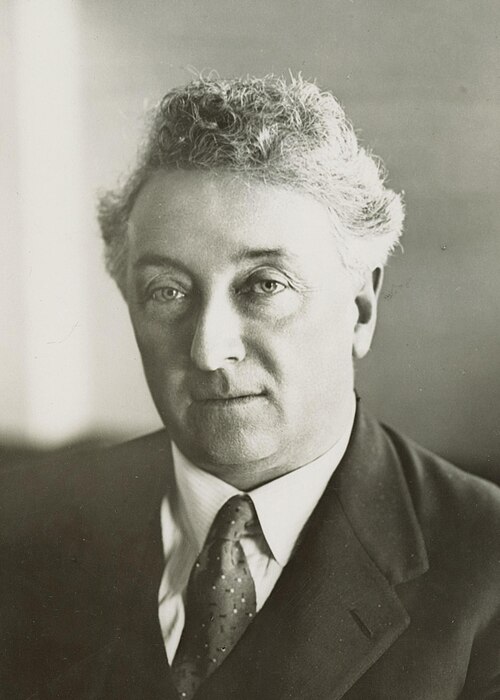
Biography
Joseph Aloysius Lyons was born on 15 September 1879 at Stanley, on the north-west coast of Tasmania, into a large Irish-Catholic family. His father's business failed when Joseph was a boy, and he left school for a time to work as a messenger and labourer before an aunt's support allowed him to resume his studies. He trained as a pupil-teacher, attended the Teachers' Training College in Hobart, and taught at a number of country schools, where he became active in the teachers' association and in the emerging labour movement.
Lyons won the Tasmanian House of Assembly seat of Wilmot for Labor in 1909. He served as Treasurer, Minister for Education and Minister for Railways in John Earle's Labor government from 1914 to 1916, and became party leader in Tasmania after Earle left the party over his support for conscription, which Lyons opposed. In 1915 he married Enid Burnell, who would become a significant political figure in her own right; the couple had twelve children. Lyons served as Premier of Tasmania from October 1923 to June 1928, earning a reputation for pragmatic, consensual administration and careful financial management.
Lyons entered federal politics at the October 1929 election, winning the House of Representatives seat of Wilmot as Labor swept to power under James Scullin. He became Postmaster-General and Minister for Works and Railways. When Treasurer Edward Theodore stood aside in 1930, Lyons served as acting Treasurer and, with the government's deputy leader James Fenton, championed orthodox policies of balanced budgets and the honouring of debts, including a successful public conversion loan. The return of Theodore and the caucus's support for more expansionary measures led Lyons to resign from the ministry in early 1931.
Lyons and a small group of Labor members subsequently crossed the floor and joined with the Nationalist opposition and citizens' movements to form the United Australia Party in May 1931, with Lyons as leader. To his former colleagues his departure was a betrayal; to his supporters it reflected conviction about economic policy during the Depression. After the Scullin government fell in November 1931, the UAP won a decisive victory at the December election, and Lyons was sworn in as prime minister on 6 January 1932.
The Lyons government implemented the deflationary Premiers' Plan, presided over a gradual economic recovery and took part in the 1932 Ottawa conference that established imperial trade preferences. It won further elections in 1934 and 1937, governing in coalition with the Country Party from late 1934. Its later years were marked by the controversial trade diversion policy of 1936, increased defence spending as international tensions rose, and a national health and pensions insurance scheme legislated in 1938 but never brought into operation. Disagreement over the scheme's deferral prompted Robert Menzies to resign from the ministry in March 1939.
Lyons was widely regarded as an approachable and conciliatory leader, though his authority within the coalition weakened under the strain of internal disputes. He died of a heart attack in Sydney on 7 April 1939, becoming the first Australian prime minister to die in office. He was buried at Devonport, Tasmania. His widow, Dame Enid Lyons, was elected in 1943 as the first woman to sit in the House of Representatives and later became the first woman to serve in a federal cabinet.
Public debt while in office
- Debt to GDP, taking office
- 89.8% (end-1931)
- Leaving office
- 68.7% (end-1938)
- Change
- -21.1 points of GDP
Gross public debt of all levels of government as a share of GDP at the year-end nearest each change of prime minister (IMF). Compare every prime minister.