6th Prime Minister of Australia
Joseph Cook
Commonwealth Liberal prime minister of Australia, 1913–1914.
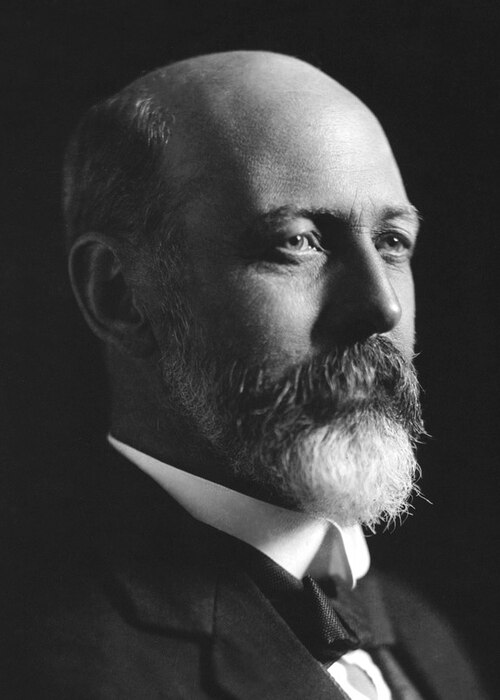
Biography
Joseph Cook was born on 7 December 1860 at Silverdale, Staffordshire, England. After his father, a coal miner, was killed in a mining accident, Cook began working in the pits as a boy to help support the family. He was a Primitive Methodist lay preacher and educated himself through reading and chapel activities, developing an interest in trade unionism and the ideas of free trade and land reform.
In 1885 Cook emigrated to New South Wales and settled at Lithgow, where he worked in the coal mines and became secretary of the local miners' lodge. He was a founder of the Labor Electoral League in the district and in 1891 was elected to the Legislative Assembly for Hartley as one of the first group of Labor members. He became leader of the parliamentary Labor group in 1893, but in 1894 he refused to sign the pledge binding members to caucus decisions and left the party. He then served as Postmaster-General in George Reid's Free Trade government from 1894 and as Minister for Mines and Agriculture from 1898 to 1899.
At the first federal election in 1901 Cook won the seat of Parramatta for the Free Trade Party and held it until 1921. He became deputy to Reid and, when Reid stepped down in 1908, succeeded him as leader of what had become the Anti-Socialist Party. In 1909 Cook negotiated the Fusion with Alfred Deakin's Protectionists, forming the Commonwealth Liberal Party, and served as Minister for Defence in Deakin's third government, overseeing the introduction of compulsory military training and early steps in creating an Australian navy.
After Deakin retired, Cook was elected Liberal leader in January 1913. At the election that May the Liberals won the House of Representatives by a single seat, while Labor retained control of the Senate. Cook was sworn in as prime minister on 24 June 1913. Facing an obstructive Senate and a fragile majority, he introduced legislation to abolish preference to unionists in government employment and, when the Senate twice rejected it, sought and obtained the first double dissolution of the federal Parliament in 1914.
The First World War broke out during the ensuing campaign, and Cook's government placed the Royal Australian Navy under British Admiralty control and offered an expeditionary force to Britain. At the election of 5 September 1914 the Liberals were defeated by Andrew Fisher's Labor Party, and Cook left office on 17 September 1914.
In 1917 Cook led most Liberals into the Nationalist Party with Billy Hughes and the National Labor members who had left Labor over conscription. He served as Minister for the Navy from 1917 to 1920, attended the 1919 Paris Peace Conference with Hughes, and was Treasurer from 1920 to 1921. He resigned from Parliament in 1921 to become Australian High Commissioner in London, a post he held until 1927. He was appointed GCMG in 1918.
After returning to Australia, Cook chaired a royal commission into South Australian finances and lived quietly in retirement in Sydney. He died at Bellevue Hill on 30 July 1947. He is remembered as one of the founders of the Labor Party in New South Wales who became a leading figure of its opponents, and as the prime minister who first used the double dissolution provision of the Constitution.
Public debt while in office
- Debt to GDP, taking office
- 37.4% (end-1912)
- Leaving office
- 38.1% (end-1914)
- Change
- +0.7 points of GDP
Gross public debt of all levels of government as a share of GDP at the year-end nearest each change of prime minister (IMF). Compare every prime minister.