25th Prime Minister of Australia
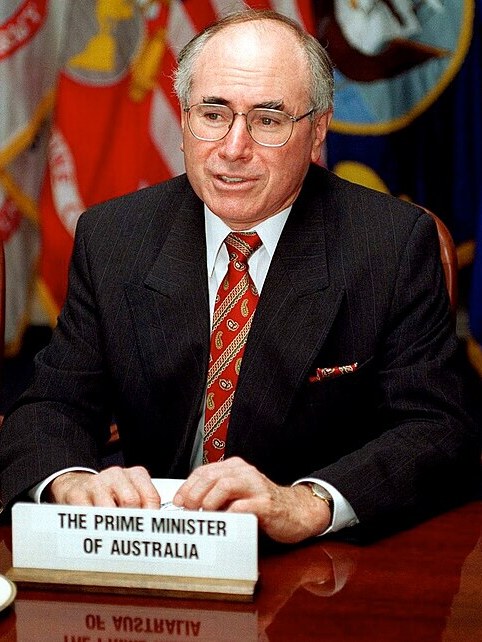
John Howard
Liberal prime minister of Australia, 1996–2007.
Biography
John Winston Howard was born on 26 July 1939 in the Sydney suburb of Earlwood, the youngest of four sons of a family that ran a service station. He attended Canterbury Boys' High School and studied law at the University of Sydney, graduating in 1961. He joined the Liberal Party as a teenager and was active in the Young Liberals.
Howard practised as a solicitor in Sydney for more than a decade. He stood unsuccessfully for the state seat of Drummoyne in 1968 before winning preselection for the federal seat of Bennelong in Sydney's north-west.
Howard was elected to the House of Representatives for Bennelong at the 1974 election. After the Fraser government took office he served as Minister for Business and Consumer Affairs and Minister for Special Trade Negotiations, and from 1977 to 1983 was Treasurer. He became deputy leader of the Liberal Party in 1982 and, after the party's defeat in 1983, remained deputy to Andrew Peacock.
Howard became Leader of the Opposition in 1985 and led the Coalition to defeat at the 1987 election. He was replaced by Peacock in 1989 and spent several years on the frontbench and backbench before returning to the leadership on 30 January 1995. The Coalition won the election of 2 March 1996 decisively, and Howard was sworn in as Australia's 25th Prime Minister on 11 March 1996.
Soon after taking office Howard responded to the Port Arthur massacre of April 1996 by securing agreement with the states on the National Firearms Agreement, which banned many semi-automatic and pump-action firearms and funded a buyback. His government reduced the budget deficit, passed the Workplace Relations Act 1996, began the staged privatisation of Telstra and, after winning the 1998 election on the issue, introduced a goods and services tax from 1 July 2000. In 1999 Australia led the international peacekeeping force in East Timor, and a referendum on becoming a republic was defeated. Following the Tampa affair in 2001, the government adopted offshore processing of asylum seekers. The Coalition won further elections in 2001 and 2004. Howard committed Australian forces to Afghanistan in 2001 and Iraq in 2003, established the Future Fund, and after gaining a Senate majority in 2005 introduced the WorkChoices industrial relations changes. In 2007 the government launched the Northern Territory Emergency Response.
The Coalition lost the election of 24 November 2007 to Labor under Kevin Rudd, and Howard lost Bennelong to Maxine McKew, becoming only the second sitting prime minister to lose his own seat. He is Australia's second-longest-serving prime minister, after Sir Robert Menzies. He was appointed a Companion of the Order of Australia in 2008 and to the Order of Merit in 2012, published a memoir, Lazarus Rising, in 2010, and has remained a commentator on public affairs. He married Janette Parker in 1971, and they have three children.
Public debt while in office
- Debt to GDP, taking office
- 31.1% (end-1995)
- Leaving office
- 9.7% (end-2007)
- Change
- -21.4 points of GDP
- In dollars (at the time)
- $154.4 billion → $105.8 billion
Gross public debt of all levels of government as a share of GDP at the year-end nearest each change of prime minister (IMF). Compare every prime minister.