14th Prime Minister of Australia
John Curtin
Labor prime minister of Australia, 1941–1945.
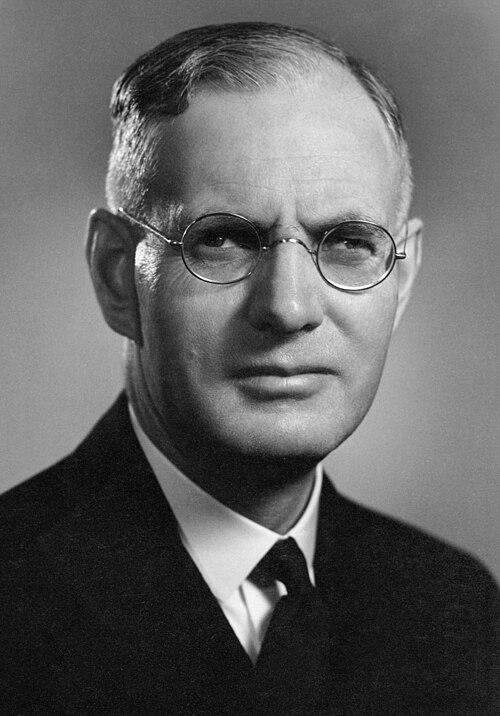
Biography
John Joseph Curtin was born on 8 January 1885 at Creswick, Victoria, the son of an Irish-born police officer. The family moved several times before settling in Melbourne. He left school at about 13 and worked in a range of jobs, including as an office boy, a copy boy and a clerk at a manufacturing company. Largely self-educated, he became involved in socialist and labour politics, joining the Victorian Socialist Party and becoming secretary of the Timber Workers' Union in Victoria.
Curtin was a prominent opponent of conscription during the First World War and was briefly imprisoned in 1916 for failing to comply with wartime enlistment requirements. In 1917 he moved to Perth to edit the Westralian Worker, the newspaper of the Western Australian labour movement, and married Elsie Needham that year. He represented Australia at an International Labour Organization conference in 1924 and served on a royal commission into child endowment.
He won the federal seat of Fremantle in 1928, lost it in the anti-Labor swing of 1931 and regained it in 1934. In October 1935 he was elected leader of the Labor Party, narrowly defeating Frank Forde, and worked to reunite a party divided by the splits of the Depression years. Labor came close to winning the 1940 election. In October 1941 the two independents who held the balance of power voted against Arthur Fadden's budget, and Curtin was sworn in as Prime Minister on 7 October 1941.
Two months later, Japan entered the war. In a newspaper message at the end of December 1941 Curtin declared that Australia looked to the United States, a statement that came to symbolise a shift in Australian strategic outlook. In early 1942 he insisted, against the wishes of British Prime Minister Winston Churchill, that Australian divisions returning from the Middle East be brought home rather than diverted to Burma. Following the fall of Singapore and the bombing of Darwin, his government placed Australian forces under the command of United States General Douglas MacArthur in the South West Pacific Area and mobilised the economy for total war, including manpower controls and rationing.
The government passed legislation adopting the Statute of Westminster, and in 1942 introduced uniform income taxation, giving the Commonwealth control of income tax. Curtin, a lifelong opponent of conscription for overseas service, persuaded his party in 1943 to allow conscripted militia to serve in a defined area beyond Australian territory. Labor won a decisive victory at the election of 21 August 1943, gaining majorities in both houses. The government expanded social welfare with widows' pensions and unemployment and sickness benefits, and began planning for post-war reconstruction.
The strain of wartime leadership affected Curtin's health, and he suffered a heart attack in late 1944. He died at the Lodge in Canberra on 5 July 1945, weeks before the end of the war in the Pacific, and was buried in Karrakatta Cemetery in Perth. He is widely regarded as one of Australia's most significant prime ministers for his leadership during the Second World War.
Public debt while in office
- Debt to GDP, taking office
- 66.5% (end-1941)
- Leaving office
- 89.7% (end-1945)
- Change
- +23.2 points of GDP
Gross public debt of all levels of government as a share of GDP at the year-end nearest each change of prime minister (IMF). Compare every prime minister.