9th Prime Minister of Australia
James Scullin
Labor prime minister of Australia, 1929–1932.
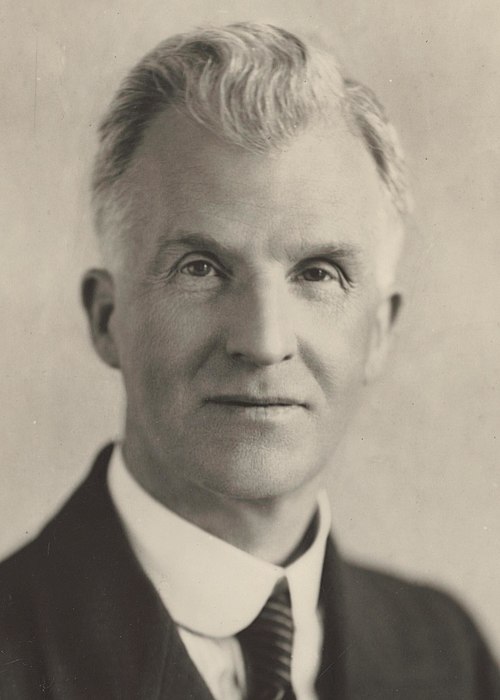
Biography
James Henry Scullin was born on 18 September 1876 at Trawalla, near Ballarat in Victoria, the son of Irish-born Catholic parents. He attended the local state school until his early teens and then worked in a variety of jobs, including as a grocer's assistant and later as proprietor of his own grocery in Ballarat. Largely self-educated, he read widely, attended night classes and was an active member of debating societies and Catholic organisations, interests that shaped his lifelong commitment to the labour movement.
Scullin joined the Political Labor Council and worked as an organiser for the Australian Workers' Union. In 1910 he won the federal seat of Corangamite for Labor, but he was defeated in 1913. He then became editor of the Ballarat Evening Echo, a Labor newspaper, and remained prominent in the party's Victorian organisation. He opposed conscription during the First World War and was closely involved in drafting the party's platform in the post-war years.
Scullin returned to the House of Representatives at a by-election for the Melbourne seat of Yarra in 1922, which he held until his retirement in 1949. He quickly became known as one of Labor's most capable debaters, particularly on financial questions, and was elected deputy leader before succeeding Matthew Charlton as leader of the federal parliamentary party in 1928.
At the election of 12 October 1929 Labor won a large majority in the House of Representatives, and Scullin was sworn in as prime minister on 22 October 1929, the first Labor leader to take office in Canberra. Within days, however, the Wall Street crash signalled the onset of the Great Depression. Australia's export prices collapsed, unemployment rose sharply and the government lacked a majority in the Senate, which blocked or amended much of its legislation. The Commonwealth Bank board and the states also constrained its options.
The government ended compulsory military training, encouraged wheat growers to expand production in 1930 only to see prices fall dramatically, and, after Scullin's attendance at the 1930 Imperial Conference in London, secured the appointment of Sir Isaac Isaacs as the first Australian-born Governor-General. Policy divisions deepened over how to respond to the crisis: some members, led by Joseph Lyons, favoured orthodox retrenchment, while supporters of New South Wales Premier Jack Lang demanded more radical measures. The government ultimately adopted the 1931 Premiers' Plan, which cut public spending and pensions. Lyons and others left to help form the United Australia Party, and in November 1931 Lang's followers in the House voted with the opposition to defeat the government. Labor was heavily beaten at the election of 19 December 1931, and Scullin left office on 6 January 1932.
Scullin led the opposition until 1935, when ill health contributed to his decision to stand down in favour of John Curtin. He remained in Parliament as a respected elder figure and gave valued advice on financial matters to the Curtin and Chifley governments during the Second World War, including on the introduction of uniform income taxation. He retired at the 1949 election and died in Melbourne on 28 January 1953. Assessments of his government generally emphasise the extraordinary economic circumstances and institutional obstacles it faced.
Public debt while in office
- Debt to GDP, taking office
- 63.8% (end-1929)
- Leaving office
- 89.8% (end-1931)
- Change
- +26 points of GDP
Gross public debt of all levels of government as a share of GDP at the year-end nearest each change of prime minister (IMF). Compare every prime minister.