17th Prime Minister of Australia
Harold Holt
Liberal prime minister of Australia, 1966–1967.
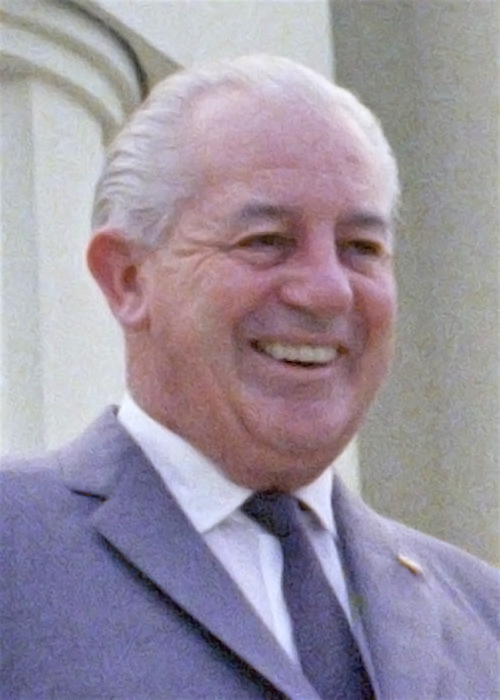
Biography
Harold Edward Holt was born on 5 August 1908 in Stanmore, Sydney. His parents' work and later separation meant he spent much of his childhood at boarding school, attending Wesley College in Melbourne. He studied law at the University of Melbourne, where he lived at Queen's College and was a keen sportsman and debater.
Holt practised as a solicitor in Melbourne and became involved in the United Australia Party. After an unsuccessful attempt to win Kooyong, he entered the House of Representatives at a by-election for Fawkner in 1935. He transferred to the new seat of Higgins in 1949 and held it until his death. Holt joined the Menzies ministry in 1939 and briefly served as a gunner in the Second Australian Imperial Force in 1940, returning to Parliament and the ministry as Minister for Labour and National Service after the Canberra air disaster killed three ministers.
When the Coalition returned to office in 1949, Holt became Minister for Immigration and Minister for Labour and National Service, overseeing the continued expansion of the post-war migration program and developing a reputation for conciliatory dealings with unions and employers. He became deputy leader of the Liberal Party in 1956 and Treasurer in 1958. His credit restrictions of 1960, intended to curb inflation, contributed to a sharp economic slowdown and to the government's near defeat at the 1961 election. As Treasurer he also oversaw preparations for the introduction of decimal currency.
Holt succeeded Robert Menzies as Liberal leader and was sworn in as Prime Minister on 26 January 1966. Decimal currency was introduced weeks later, in February 1966. His government expanded Australia's military commitment in Vietnam, and his remark 'All the way with LBJ', made during a visit to Washington in 1966, became a widely quoted expression of his alignment with United States President Lyndon Johnson. At the election of 26 November 1966 the Coalition won a large majority, with Vietnam and conscription prominent issues. Holt's government also relaxed the restrictions of the White Australia policy, allowing more non-European migrants to settle and become citizens, and paid increasing attention to Asia.
In May 1967 Holt's government held a referendum that removed two references to Aboriginal people from the Constitution, enabling the Commonwealth to make laws for them and to include them in population counts; it was approved by more than 90 per cent of voters. The government also established the Council for Aboriginal Affairs and announced the creation of the Australian Council for the Arts. In November 1967 Australia chose not to follow Britain's devaluation of sterling. Holt's standing had been weakened during 1967 by a poor Senate election result and controversy over the government's use of VIP aircraft.
On 17 December 1967 Holt went swimming at Cheviot Beach near Portsea, Victoria, and disappeared in heavy surf. Despite an extensive search his body was never found, and a later coronial inquest concluded that he had drowned. He was survived by his wife, Zara, whom he had married in 1946. John McEwen served as caretaker Prime Minister until the Liberal Party elected John Gorton as Holt's successor.
Public debt while in office
- Debt to GDP, taking office
- 43.7% (end-1965)
- Leaving office
- 40.5% (end-1967)
- Change
- -3.2 points of GDP
- In dollars (at the time)
- $10.2 billion → $11.0 billion
Gross public debt of all levels of government as a share of GDP at the year-end nearest each change of prime minister (IMF). Compare every prime minister.