21st Prime Minister of Australia
Gough Whitlam
Labor prime minister of Australia, 1972–1975.
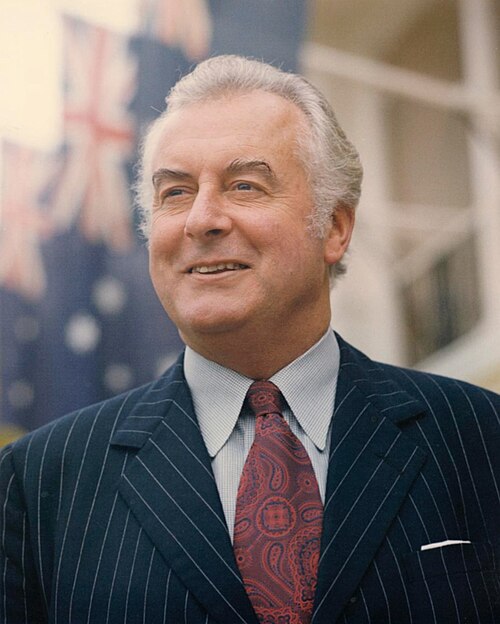
Biography
Edward Gough Whitlam was born on 11 July 1916 in the Melbourne suburb of Kew. His father, Fred Whitlam, was a senior Commonwealth public servant who later became Crown Solicitor, and the family's moves took the young Whitlam to Sydney and then to Canberra, where he attended Canberra Grammar School. He studied arts and law at the University of Sydney. During the Second World War he enlisted in the Royal Australian Air Force and served as a navigator, flying operational missions in the Pacific. In 1942 he married Margaret Dovey, who would become a prominent public figure in her own right.
After the war Whitlam completed his legal studies and was admitted to the New South Wales Bar in 1947, building a practice in Sydney. He had joined the Australian Labor Party in 1945, partly in response to the defeat of the 1944 referendum seeking expanded Commonwealth powers for post-war reconstruction. After unsuccessful attempts at local and state preselection, he won the federal seat of Werriwa, in Sydney's south-western outer suburbs, at a by-election in November 1952. He would hold the electorate for more than 25 years.
Whitlam quickly gained a reputation as a forceful debater and a reformer interested in the machinery of government and the federation. He served on the Joint Committee on Constitutional Review in the late 1950s and became deputy leader of the Labor Party in 1960 under Arthur Calwell. Following Labor's heavy defeat at the 1966 election, Whitlam succeeded Calwell as leader in February 1967. He set about modernising the party's platform and challenging the authority of its federal conference and executive, and led Labor to a substantial recovery at the 1969 election.
Labor won the election of 2 December 1972 under the slogan 'It's Time', ending 23 years of Coalition government. Before the full ministry was chosen, Whitlam and his deputy Lance Barnard governed for about two weeks as a two-man ministry, using that period to end conscription, release those imprisoned for draft resistance, complete the withdrawal of Australian forces from Vietnam and establish diplomatic relations with the People's Republic of China. Over the following three years the government abolished university tuition fees, greatly increased Commonwealth funding for schools, introduced the universal health insurance scheme Medibank, passed the Racial Discrimination Act 1975 and the Family Law Act 1975, which introduced no-fault divorce, and created the Order of Australia. It removed the remaining racial criteria from immigration policy and took early steps towards Aboriginal land rights, symbolised by Whitlam's handover of land to the Gurindji people at Wattie Creek in 1975.
The government faced a hostile Senate throughout its term. In 1974 Whitlam obtained a double dissolution and was returned at the election of 18 May, after which a joint sitting of both houses passed several blocked bills, including the Medibank legislation. The government's second term was marked by high inflation and unemployment following the international oil shock, ministerial resignations and controversy over attempts to raise large overseas loans through unconventional channels, known as the Loans Affair. In October 1975 the Opposition-controlled Senate deferred consideration of the budget appropriation bills. On 11 November 1975 the Governor-General, Sir John Kerr, withdrew Whitlam's commission and appointed the Opposition leader, Malcolm Fraser, as caretaker Prime Minister pending an election. The dismissal remains one of the most debated events in Australian political history, with continuing disagreement over the Senate's use of its power over supply, the Governor-General's exercise of the reserve powers and the manner in which the decision was made.
At the election of 13 December 1975 the Coalition won a large majority. Whitlam remained Opposition leader but led Labor to a second heavy defeat in 1977, after which he stepped down from the leadership. He resigned from Parliament in 1978. In later years he held visiting academic posts, wrote extensively about his government, served as Australia's ambassador to UNESCO from 1983 to 1986 and was active in cultural and heritage bodies. Margaret Whitlam died in 2012. Gough Whitlam died in Sydney on 21 October 2014, aged 98, and was honoured with a state memorial service.
Public debt while in office
- Debt to GDP, taking office
- 30.7% (end-1972)
- Leaving office
- 23.6% (end-1975)
- Change
- -7.1 points of GDP
- In dollars (at the time)
- $13.7 billion → $16.8 billion
Gross public debt of all levels of government as a share of GDP at the year-end nearest each change of prime minister (IMF). Compare every prime minister.