4th Prime Minister of Australia
George Reid
Free Trade prime minister of Australia, 1904–1905.
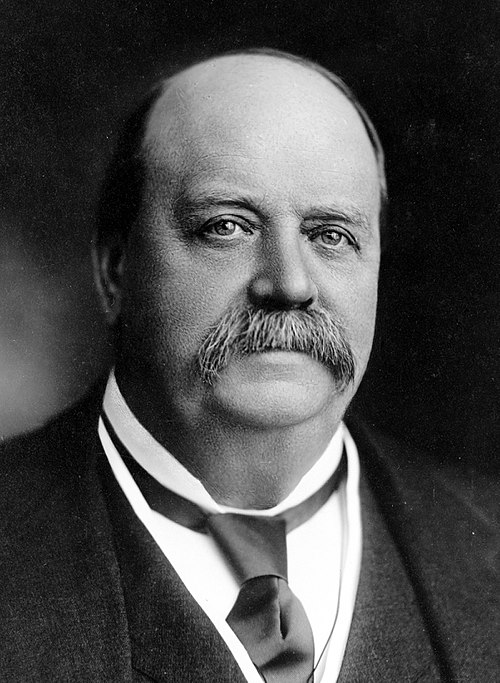
Biography
George Houstoun Reid was born on 25 February 1845 at Johnstone in Renfrewshire, Scotland, the son of a Presbyterian minister. The family emigrated to Melbourne in 1852, where he briefly attended Scotch College, and moved to Sydney in 1858. Reid left school young and worked as a merchant's clerk before joining the New South Wales public service in the Colonial Treasury. He rose to become secretary to the Attorney-General's department, studied law in his spare time and was admitted to the bar in 1879. He also published an influential pamphlet defending free trade.
Reid was elected to the Legislative Assembly for East Sydney in 1880. As Minister for Public Instruction in Alexander Stuart's government from 1883 to 1884 he reformed the administration of education and helped lay the groundwork for technical education and the extension of the university. Witty, rotund and an outstanding platform speaker, he became leader of the Free Trade Party in 1891 and Premier of New South Wales in 1894.
Reid's premiership, which lasted until 1899, introduced direct land and income taxes to replace tariff revenue, reformed the civil service and public finance, and pursued free trade. A supporter of Federation in principle, he took part in the 1897–98 Federal Convention but was critical of aspects of the draft Constitution, and his equivocal stance during the 1898 referendum campaign earned him the nickname 'Yes–No Reid'. He secured several amendments at a premiers' conference in 1899, after which he campaigned for the Constitution's acceptance. He lost office later that year.
At the first federal election in 1901 Reid won the seat of East Sydney and became the first Leader of the Opposition as head of the Free Trade Party. In August 1904, after Chris Watson's Labor government resigned, Reid formed a minority government on 18 August 1904 in coalition with a group of Protectionists led by Allan McLean. During its brief life the government secured passage of the Conciliation and Arbitration Act 1904, which established the Commonwealth Court of Conciliation and Arbitration, an issue that had brought down the two previous governments.
The government depended on Protectionist goodwill, and in mid-1905 Alfred Deakin signalled that his party would no longer support it. Reid lost office on 5 July 1905, and Deakin returned as prime minister with Labor support. Reid campaigned at the 1906 election on an anti-socialist platform directed at Labor, and his party made gains but remained in opposition. He resigned the leadership in 1908 in favour of Joseph Cook.
Reid left the Parliament at the end of 1909 and in 1910 became the first Australian High Commissioner in London, a post he held until 1916. He was a popular public figure in Britain, particularly during the First World War. In 1916 he was elected unopposed to the House of Commons for St George's, Hanover Square, making him one of the few people to have sat in colonial, Australian and British parliaments. He was knighted in 1909 and received further honours in later years. He died in London on 12 September 1918.
Public debt while in office
- Debt to GDP, taking office
- 47.9% (end-1904)
- Leaving office
- 49.1% (end-1905)
- Change
- +1.2 points of GDP
Gross public debt of all levels of government as a share of GDP at the year-end nearest each change of prime minister (IMF). Compare every prime minister.