1st Prime Minister of Australia
Edmund Barton
Protectionist prime minister of Australia, 1901–1903.
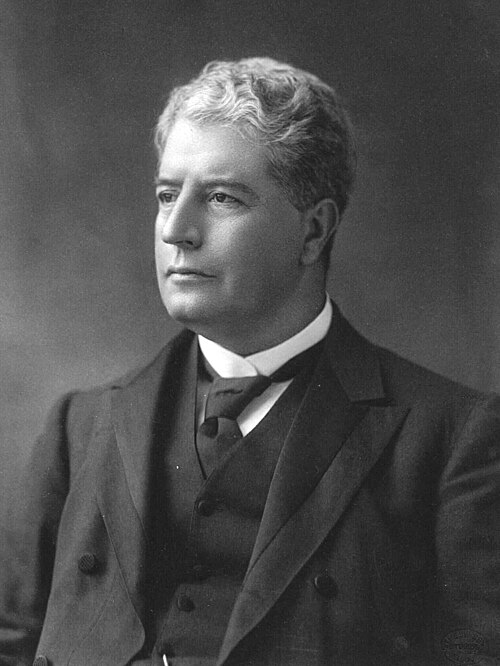
Biography
Edmund Barton was born on 18 January 1849 in Glebe, Sydney, the youngest son of English-born parents; his father was a stockbroker and accountant. He was educated at Sydney Grammar School, where he was dux, and at the University of Sydney, graduating with first-class honours in classics. He was admitted to the New South Wales bar in 1871 and developed a legal practice while maintaining interests in cricket, literature and university affairs.
Barton was elected to the Legislative Assembly for the University of Sydney in 1879 and later represented other seats. He served as Speaker of the Assembly from 1883 to 1887, earning a reputation for impartiality and procedural skill, and was Attorney-General in the governments of George Dibbs in 1889 and again from 1891 to 1893. A protectionist, he also served periods in the Legislative Council.
Barton became the leading figure in the movement for Federation in New South Wales after Sir Henry Parkes. He attended the 1891 National Australasian Convention, campaigned tirelessly through the 1890s, and was leader of the 1897–98 Federal Convention, where he chaired the drafting committee that shaped much of the Constitution. In 1900 he led the delegation to London that negotiated the passage of the Commonwealth of Australia Constitution Act through the British Parliament.
When the first Governor-General, Lord Hopetoun, invited the New South Wales Premier, Sir William Lyne, to form the first federal ministry, Lyne was unable to secure the support of leading federalists, and Barton was commissioned instead. He was sworn in as Australia's first prime minister on 1 January 1901, leading a Protectionist ministry that included several former colonial premiers. At the first federal election in March 1901 he won the seat of Hunter, and his government held office with the support of the Labor members.
Barton's government established the institutions of the new Commonwealth. Among its earliest measures were the Immigration Restriction Act 1901, which used a dictation test to exclude non-European migrants, and the Pacific Island Labourers Act 1901, which provided for the deportation of most Pacific Islander workers. Together these formed the legislative foundation of the White Australia policy, which enjoyed broad parliamentary support at the time but is now widely recognised as racially discriminatory. The government also passed the first federal tariff, the Commonwealth Franchise Act 1902, which gave most women the right to vote and stand for federal Parliament while excluding most Aboriginal people and others on racial grounds, the Defence Act 1903 and the Judiciary Act 1903, which created the High Court of Australia.
Barton resigned as prime minister on 24 September 1903 to become one of the three founding justices of the High Court, and was succeeded by Alfred Deakin. He had been appointed GCMG in 1902. On the bench he was regarded as a careful and moderate judge who, with his colleagues, did much to establish the Court's early jurisprudence on the federal division of powers.
Barton remained a justice of the High Court for the rest of his life, although illness increasingly limited his work in his final years. He died of heart failure at Medlow Bath in the Blue Mountains of New South Wales on 7 January 1920 and was buried in Sydney. He is remembered chiefly as the principal architect of Federation and the founding leader of the Commonwealth government.
Public debt while in office
- Debt to GDP, taking office
- 50.9% (end-1900)
- Leaving office
- 49.7% (end-1903)
- Change
- -1.2 points of GDP
Gross public debt of all levels of government as a share of GDP at the year-end nearest each change of prime minister (IMF). Compare every prime minister.