11th Prime Minister of Australia
Earle Page
Country prime minister of Australia, 1939.
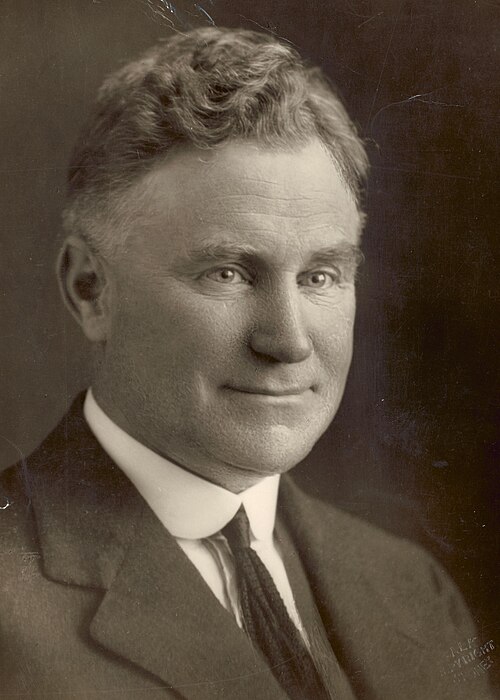
Biography
Earle Christmas Grafton Page was born on 8 August 1880 at Grafton, New South Wales, one of a large family. He was educated at Grafton Public School and Sydney Boys High School and studied medicine at the University of Sydney, graduating with distinction. He established a surgical practice in Grafton and built a private hospital there. During the First World War he served with the Australian Army Medical Corps. He also became involved in regional development, campaigning for new states in northern New South Wales and for hydro-electric development, and served as mayor of Grafton.
Page won the federal seat of Cowper in 1919 and became leader of the newly formed Country Party in 1921. After the 1922 election he made his party's support conditional on the removal of Billy Hughes as prime minister, leading to the formation of the Bruce–Page coalition in 1923. As Treasurer from 1923 to 1929 he was instrumental in the Financial Agreement of 1927, which created the Australian Loan Council and reshaped Commonwealth–state financial relations. The coalition was defeated in 1929, and Page later served as Minister for Commerce in the Lyons Government from 1934. He was knighted in 1938.
When Joseph Lyons died on 7 April 1939, Page, as leader of the junior coalition party, was sworn in as Prime Minister pending the election of a new United Australia Party leader. When Robert Menzies was chosen, Page refused to serve under him and made a personal attack on Menzies in the House of Representatives, citing among other things his failure to serve in the First World War. Menzies became Prime Minister on 26 April 1939 and the Country Party withdrew from the coalition. Page's attack proved unpopular within his own party and he resigned the leadership later in 1939.
Page returned to the ministry in 1940 and served in London as Australia's representative to the British War Cabinet in 1941–42. In the Menzies Government formed in 1949 he became Minister for Health, introducing the pharmaceutical benefits and health insurance arrangements of the National Health Act 1953, which subsidised voluntary insurance schemes. He was the founding chancellor of the University of New England. Page lost Cowper at the election of December 1961 after 42 years in Parliament, and died in Sydney on 20 December 1961, before he had learned of the result.
Public debt while in office
- Debt to GDP, taking office
- 68.7% (end-1938)
- Leaving office
- 68.7% (end-1938)
- Change
- +0 points of GDP
Gross public debt of all levels of government as a share of GDP at the year-end nearest each change of prime minister (IMF). Compare every prime minister.