23rd Prime Minister of Australia
Bob Hawke
Labor prime minister of Australia, 1983–1991.
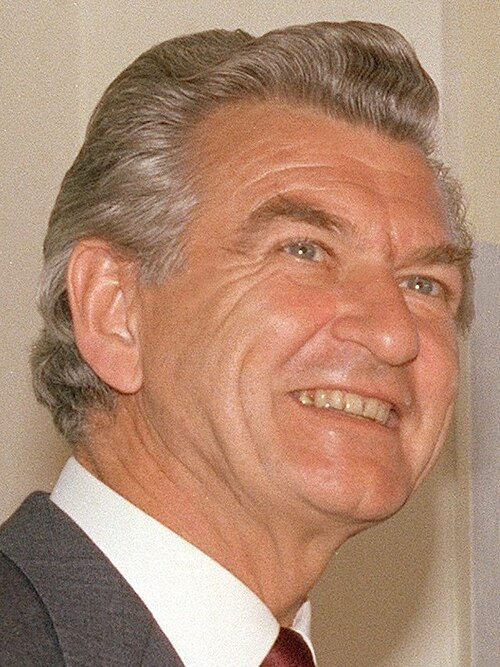
Biography
Robert James Lee Hawke was born on 9 December 1929 in Bordertown, South Australia, the son of a Congregational minister. The family moved to Western Australia, where he attended Perth Modern School and the University of Western Australia, graduating in arts and law. As a Rhodes Scholar he studied at University College, Oxford, completing a Bachelor of Letters thesis on wage-fixing in Australia.
After a period as a research scholar at the Australian National University, Hawke joined the Australian Council of Trade Unions in 1958 as a research officer and advocate, representing unions in national wage cases. He was elected president of the ACTU in 1969, taking office in 1970, and held the post until 1980, becoming one of the best-known public figures in the country. He also served as federal president of the Australian Labor Party from 1973 to 1978.
Hawke was elected to the House of Representatives for the Melbourne seat of Wills at the 1980 election and joined the opposition frontbench. He narrowly failed to replace Bill Hayden as leader in July 1982, but on 3 February 1983 Hayden resigned and Hawke was elected leader, on the same day Prime Minister Malcolm Fraser called an election. Labor won the election of 5 March 1983, and Hawke was sworn in as Australia's 23rd Prime Minister on 11 March 1983.
Hawke governed through consensus, beginning with a National Economic Summit and the Prices and Incomes Accord between the government and the union movement. With Treasurer Paul Keating, his government floated the dollar, deregulated the financial sector, reduced tariffs and later privatised several state-owned enterprises. It introduced Medicare in 1984, expanded secondary school retention, introduced the Higher Education Contribution Scheme in 1989, and passed the Sex Discrimination Act 1984. Advance Australia Fair was proclaimed the national anthem in 1984. The government blocked the Franklin Dam in Tasmania, worked to secure a ban on mining in Antarctica, and promoted the creation of Asia-Pacific Economic Cooperation in 1989. Australia contributed forces to the 1991 Gulf War.
Hawke led Labor to further election victories in 1984, 1987 and 1990, making him the most electorally successful Labor leader. Amid recession and tension over a private agreement to hand over to Keating, he defeated Keating's first challenge in June 1991, but lost a second ballot on 19 December 1991 by 56 votes to 51 and left office the following day. He is Labor's longest-serving prime minister.
Hawke resigned from Parliament in February 1992 and later pursued business and consulting interests, particularly in relation to China, and remained a popular public figure. He married Hazel Masterson in 1956, and they had four children, one of whom died in infancy; they divorced in 1995, and he then married the writer Blanche d'Alpuget. Hawke died at his home in Sydney on 16 May 2019, aged 89, two days before that year's federal election.
Public debt while in office
- Debt to GDP, taking office
- 16.8% (end-1982)
- Leaving office
- 21.6% (end-1991)
- Change
- +4.8 points of GDP
- In dollars (at the time)
- $29.6 billion → $89.8 billion
Gross public debt of all levels of government as a share of GDP at the year-end nearest each change of prime minister (IMF). Compare every prime minister.