7th Prime Minister of Australia
Billy Hughes
Nationalist prime minister of Australia, 1915–1923.
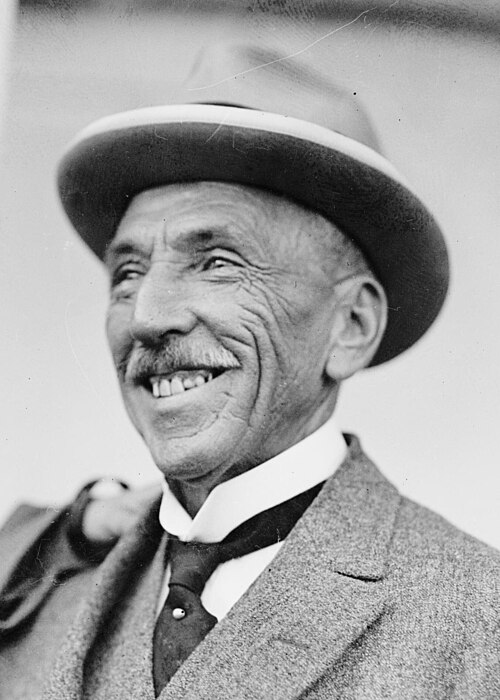
Biography
William Morris Hughes was born on 25 September 1862 in Pimlico, London, to Welsh parents; his father was a carpenter and his mother died when he was a child. He spent part of his childhood with relatives in Llandudno, Wales, and later became a pupil-teacher in London. In 1884 he emigrated to Queensland and spent several years in itinerant work in the bush before settling in Sydney, where he ran a small shop in Balmain and became involved in radical and labour politics.
Hughes was involved with the Australian Socialist League and later became an organiser for maritime workers, emerging as a founder and leader of the waterside workers' union in Sydney. In 1894 he was elected to the New South Wales Legislative Assembly for the seat of Lang. Combative, quick-witted and a forceful speaker despite his slight build and deafness, he quickly became a prominent figure in the parliamentary Labor Party.
At the first federal election in 1901 Hughes won the seat of West Sydney, which he held until 1917; he later represented Bendigo from 1917 to 1922, North Sydney from 1922 to 1949 and Bradfield from 1949 until his death. While in Parliament he studied law and was admitted to the bar in 1903. He served as Minister for External Affairs in the Watson government of 1904 and as Attorney-General in each of Andrew Fisher's three governments, where he was a leading advocate of expanded Commonwealth powers.
When Fisher resigned in October 1915, Hughes was elected Labor leader and became prime minister on 27 October 1915. Convinced that voluntary enlistment could not sustain Australia's forces on the Western Front, he put the question of conscription for overseas service to a referendum on 28 October 1916. It was narrowly defeated amid bitter divisions that ran along lines of class, religion and region. The issue split the Labor Party: in November 1916 Hughes and his supporters left the caucus, formed a National Labor government and in early 1917 merged with the Liberal opposition to create the Nationalist Party. The Nationalists won the May 1917 election convincingly, but a second conscription referendum on 20 December 1917 was also defeated. Hughes was regarded as a traitor by many in the labour movement and as a determined war leader by his supporters.
At the Paris Peace Conference in 1919 Hughes insisted on separate Australian representation, secured a League of Nations mandate over the former German New Guinea and opposed Japan's proposed racial equality clause, consistent with the White Australia policy. His government established the Commonwealth Shipping Line, expanded repatriation services and won the December 1919 election. At the 1922 election the Nationalists lost their majority, and the Country Party would not join a coalition under his leadership. Hughes resigned, and Stanley Bruce succeeded him on 9 February 1923.
From the backbench Hughes became a persistent critic of Bruce, and in 1929 he helped defeat the government over its arbitration legislation, for which he was expelled from the Nationalist Party. He later joined the United Australia Party and held several portfolios under Joseph Lyons and Robert Menzies, including External Affairs, Health, Attorney-General and the Navy. After Menzies resigned in 1941, Hughes led the UAP for two years, mostly in opposition.
Hughes remained in the House of Representatives until his death at Lindfield, Sydney, on 28 October 1952, having served continuously in the federal Parliament since its first sitting in 1901 and in colonial and federal parliaments for more than 58 years. He remains one of the most controversial figures in Australian political history.
Public debt while in office
- Debt to GDP, taking office
- 44.4% (end-1915)
- Leaving office
- 63.4% (end-1922)
- Change
- +19 points of GDP
Gross public debt of all levels of government as a share of GDP at the year-end nearest each change of prime minister (IMF). Compare every prime minister.