16th Prime Minister of Australia
Ben Chifley
Labor prime minister of Australia, 1945–1949.
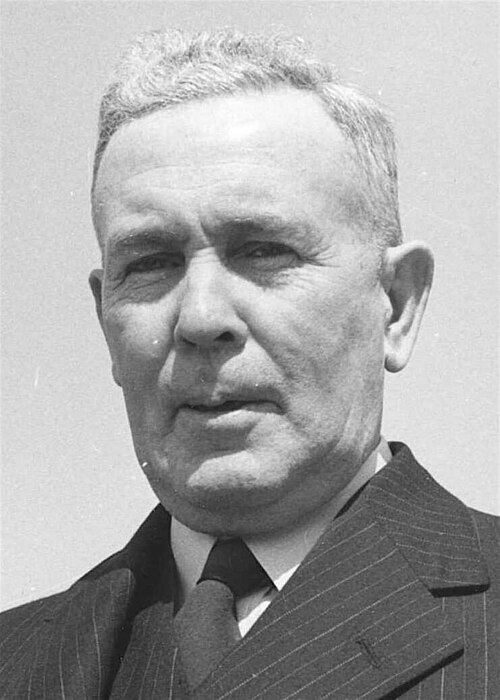
Biography
Joseph Benedict Chifley was born on 22 September 1885 in Bathurst, New South Wales, the son of a blacksmith. For much of his childhood he lived with his grandfather on a small farm at nearby Limekilns, receiving a limited formal education before returning to Bathurst schooling. He left school in his early teens and, after several jobs, joined the New South Wales Railways, eventually qualifying as one of the state's youngest engine drivers. He married Elizabeth McKenzie in 1914.
Chifley was active in the railway unions and helped found the Australian Federated Union of Locomotive Enginemen. For his part in the 1917 general strike he was demoted, an experience that strengthened his commitment to the labour movement. He studied economics and industrial law through self-education and represented his union before industrial tribunals. He also served on the Abercrombie Shire Council.
Chifley won the federal seat of Macquarie for Labor in 1928. In the Scullin Government he became Minister for Defence in 1931, but lost his seat at the election later that year amid the Labor split over economic policy. During the 1930s he served on the Royal Commission into the monetary and banking systems, where his minority report advocated nationalising private banking. He regained Macquarie in 1940 and, when Labor came to office under John Curtin in October 1941, became Treasurer, a post he held until 1949. He also served as Minister for Post-War Reconstruction from 1942 to 1945. As Treasurer he oversaw the Commonwealth's assumption of income taxing powers in 1942 and wartime financial management.
After Curtin's death on 5 July 1945 and a short interim ministry under Frank Forde, Chifley won the Labor leadership and was sworn in as Prime Minister on 13 July 1945. He led the country through demobilisation and post-war reconstruction. His government launched a large-scale immigration program under Arthur Calwell, began the Snowy Mountains Hydro-Electric Scheme in 1949, created the Commonwealth Employment Service, established the airline that became Trans Australia Airlines, took full ownership of Qantas, founded the Australian National University and expanded social security. It also supported the production of the Holden motor car. Labor won the election of 28 September 1946.
In 1947 Chifley's government legislated to nationalise the private banks, a decision that provoked strong public opposition; the High Court and then the Privy Council held the legislation invalid. In 1949 the government used troops to break a prolonged coal strike led by communist-influenced unions. Rationing, the bank nationalisation controversy and the onset of the Cold War contributed to Labor's defeat by the Menzies-led Coalition at the election of 10 December 1949. Earlier that year, Chifley had delivered his best-known speech, describing Labor's objective as a 'light on the hill'.
Chifley remained leader of the Opposition and was re-elected at the 1951 double dissolution election. He died of a heart attack in Canberra on 13 June 1951, while Parliament was sitting. He was buried in Bathurst.
Public debt while in office
- Debt to GDP, taking office
- 89.7% (end-1945)
- Leaving office
- 65.4% (end-1949)
- Change
- -24.3 points of GDP
Gross public debt of all levels of government as a share of GDP at the year-end nearest each change of prime minister (IMF). Compare every prime minister.