31st Prime Minister of Australia · In office now
Anthony Albanese
Labor prime minister of Australia, 2022–present.
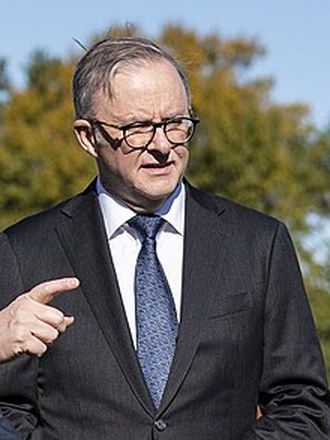
Biography
Anthony Norman Albanese was born on 2 March 1963 in Sydney and grew up in the inner-western suburb of Camperdown, where he was raised by his mother, Maryanne, in council housing. He attended St Mary's Cathedral College and went on to the University of Sydney, graduating with a Bachelor of Economics. His upbringing in public housing and his early involvement in student and Labor politics shaped the policy interests he would carry through his career, particularly housing, infrastructure and cities.
After university Albanese worked briefly at the Commonwealth Bank before becoming a research officer to the federal minister Tom Uren, a long-serving figure on the Labor left. He was elected president of Young Labor and later served as assistant general secretary of the New South Wales branch of the Australian Labor Party from 1989 to 1995. He then worked as a senior adviser to New South Wales Premier Bob Carr before seeking federal office.
Albanese was elected to the House of Representatives for the inner-Sydney seat of Grayndler at the 1996 federal election. During the long period in opposition he held a range of shadow portfolios, including environment and heritage, water and infrastructure, and was regarded as a skilled parliamentary tactician. When Labor won office in 2007 he became Leader of the House and Minister for Infrastructure, Transport, Regional Development and Local Government, overseeing a substantial national program of road, rail and port investment and the creation of Infrastructure Australia.
In June 2013, when Kevin Rudd returned to the Labor leadership, Albanese was elected deputy leader and served as Deputy Prime Minister until Labor lost office that September. He then contested the party leadership against Bill Shorten in the first ballot to include a vote of rank-and-file members; he won the membership vote but lost overall once the caucus vote was counted. After Labor's defeat at the 2019 election he was elected unopposed as Leader of the Opposition in May 2019.
Albanese led Labor to victory at the election of 21 May 2022 and was sworn in as Australia's 31st Prime Minister on 23 May. His first government legislated a target of a 43 per cent reduction in emissions below 2005 levels by 2030, established the National Anti-Corruption Commission, passed the Secure Jobs, Better Pay workplace reforms, expanded child care subsidies and set up the Housing Australia Future Fund. It continued the AUKUS partnership, announcing the pathway for Australia to acquire nuclear-powered submarines in March 2023, and restored diplomatic dialogue with China. A referendum to establish an Aboriginal and Torres Strait Islander Voice to Parliament was defeated nationally on 14 October 2023. The government also revised the legislated stage three income tax cuts to direct more relief to lower and middle-income earners, and in late 2024 legislated a minimum age of 16 for holding social media accounts.
At the federal election of 3 May 2025, Labor was returned with a significantly increased majority in the House of Representatives, making him the first prime minister to be re-elected at a general election since John Howard in 2004. Albanese formed the second Albanese ministry following the election. He has one son, Nathan, from his marriage to former New South Wales deputy premier Carmel Tebbutt, from whom he separated in 2019, and became engaged to Jodie Haydon in 2024.
Public debt while in office
- Debt to GDP, taking office
- 55.5% (end-2021)
- Latest figure
- 49.8% (end-2024)
- Change
- -5.7 points of GDP
- In dollars (at the time)
- $1.16 trillion → $1.33 trillion
Gross public debt of all levels of government as a share of GDP at the year-end nearest each change of prime minister (IMF). Compare every prime minister.