5th Prime Minister of Australia
Andrew Fisher
Labor prime minister of Australia, 1908–1909, 1910–1913 and 1914–1915.
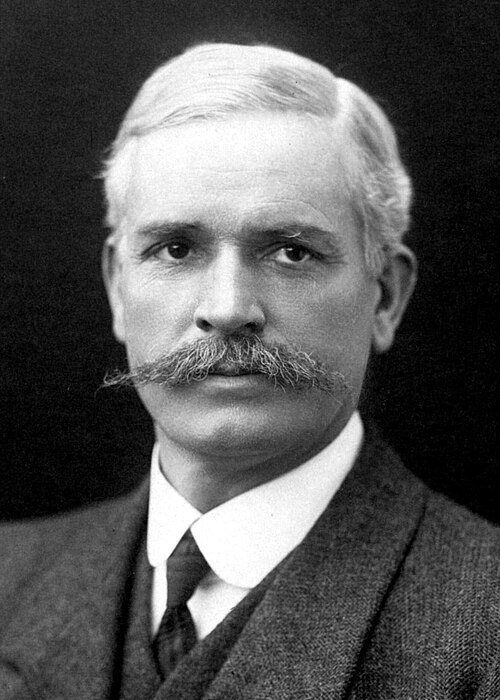
Biography
Andrew Fisher was born on 29 August 1862 at Crosshouse, near Kilmarnock in Ayrshire, Scotland, into a mining family. He began working in the local coal pits at about the age of ten, attending night school to continue his education. He was active in the co-operative movement and became secretary of a local miners' union, and his involvement in strike action left him with few prospects of employment in Scotland.
In 1885 Fisher emigrated to Queensland with his brother and worked as a miner at Burrum and later at Gympie, where he became an engine driver and a leader of the local miners' union and the Gympie branch of the Labour movement. In 1893 he was elected to the Queensland Legislative Assembly for Gympie. He lost the seat in 1896 but regained it in 1899 and served briefly as Secretary for Railways and Public Works in Anderson Dawson's short-lived Labour ministry of December 1899, often described as the first Labour government in the world.
Fisher won the federal seat of Wide Bay at the 1901 election and held it until 1915. He served as Minister for Trade and Customs in Chris Watson's government in 1904, became deputy leader of the federal Labor Party, and was elected leader when Watson stepped down in 1907. In November 1908 Labor withdrew its support from Alfred Deakin's Protectionist government, and Fisher formed a minority government on 13 November 1908. It lasted until 2 June 1909, when the newly fused anti-Labor parties combined to bring it down.
At the election of April 1910 Labor won majorities in both houses, and Fisher began his second term on 29 April 1910 at the head of the first majority federal government. It was one of the most productive in Australian history. It introduced Australian banknotes, created the Commonwealth Bank in 1911, imposed a progressive land tax on large estates, accepted the transfer of the Northern Territory from South Australia, began the transcontinental railway, introduced a maternity allowance and continued the development of the Royal Australian Navy and the national capital, which was formally named Canberra in 1913. Referendums seeking wider Commonwealth economic powers were defeated in 1911 and 1913.
At the May 1913 election Labor lost the House of Representatives to Joseph Cook's Liberals by a single seat while retaining the Senate. After Cook obtained a double dissolution, Fisher led Labor in the September 1914 election, held soon after the outbreak of the First World War. During the campaign he pledged that Australia would defend Britain to its 'last man and last shilling'. Labor won, and Fisher's third government took office on 17 September 1914. It raised and despatched the Australian Imperial Force, introduced wartime financial measures including a federal income tax in 1915, and saw Australian troops land at Gallipoli in April 1915.
The strain of wartime leadership and growing tensions within his party over war policy affected Fisher's health, and he resigned as prime minister and from Parliament on 27 October 1915, being succeeded by Billy Hughes. He then served as Australian High Commissioner in London from 1916 to 1921, during which time he sat on the Dardanelles Commission inquiring into the Gallipoli campaign. He remained in London after his term ended, his health declining, and died there on 22 October 1928.
Public debt while in office
1908–1909
- Debt to GDP, taking office
- 42.4% (end-1908)
- Leaving office
- 42.4% (end-1908)
- Change
- +0 points of GDP
1910–1913
- Debt to GDP, taking office
- 40.6% (end-1909)
- Leaving office
- 37.4% (end-1912)
- Change
- -3.2 points of GDP
1914–1915
- Debt to GDP, taking office
- 38.1% (end-1914)
- Leaving office
- 44.4% (end-1915)
- Change
- +6.3 points of GDP
Gross public debt of all levels of government as a share of GDP at the year-end nearest each change of prime minister (IMF). Compare every prime minister.