2nd Prime Minister of Australia
Alfred Deakin
Commonwealth Liberal prime minister of Australia, 1903–1904, 1905–1908 and 1909–1910.
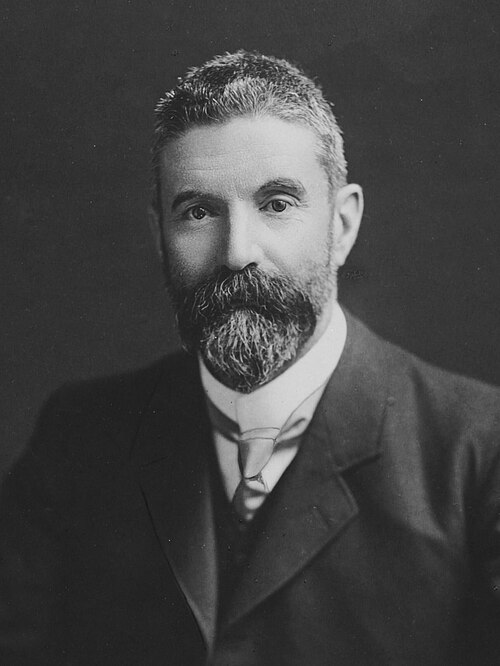
Biography
Alfred Deakin was born on 3 August 1856 in Fitzroy (Collingwood), Melbourne, the son of English immigrants. He was educated at Melbourne Church of England Grammar School and studied law at the University of Melbourne, being admitted to the bar in 1877. A thoughtful and widely read young man with strong interests in literature, philosophy and spiritualism, he found the law unrewarding and turned to journalism, writing for The Age under its proprietor David Syme, who encouraged his support for protection and introduced him to politics.
Deakin was elected to the Victorian Legislative Assembly for West Bourke in 1879, resigning immediately on a point of principle, and returned to the Assembly in 1880. He held ministerial posts from 1883, including Chief Secretary and Commissioner of Water Supply in the Gillies–Deakin coalition from 1886 to 1890, and was responsible for pioneering irrigation legislation and factory regulation. He became one of the foremost advocates of Federation, attending the conventions of the 1890s, leading the Australian Federation League in Victoria and, in 1900, travelling to London with Edmund Barton and others to secure passage of the Constitution through the British Parliament.
At the 1901 election Deakin won the seat of Ballaarat, which he held until 1913, and served as Attorney-General in Barton's Protectionist government. He oversaw the Judiciary Act 1903 establishing the High Court and spoke strongly in favour of the Immigration Restriction Act, which with other measures formed the basis of the White Australia policy; this remains the most criticised aspect of his career. When Barton moved to the High Court, Deakin became prime minister on 24 September 1903.
The 1903 election produced a House divided into three roughly equal groups. Deakin's first government fell on 27 April 1904 when Labor amended its arbitration legislation to cover state public servants, and he resigned. After the Watson and Reid governments, Deakin returned to office on 5 July 1905 with Labor support. His second government, which lasted until 13 November 1908, was a period of extensive nation-building. It pursued the 'New Protection', linking tariff protection to fair wages, which led to the Harvester judgment of 1907; it passed the Australian Industries Preservation Act, assumed responsibility for Papua, introduced invalid and old-age pensions, selected the Yass–Canberra region for the national capital and invited the United States Navy's Great White Fleet to visit in 1908. Labor withdrew its support in November 1908 and Andrew Fisher took office.
In 1909 Deakin agreed to a Fusion with Joseph Cook's Anti-Socialist Party, a move his critics saw as abandoning his liberal principles. The combined forces defeated Fisher, and Deakin's third government took office on 2 June 1909. It legislated for compulsory military training, established the basis for the Royal Australian Navy and reached a financial arrangement with the states. At the April 1910 election the Fusion was heavily defeated by Labor, and Deakin left office on 29 April 1910.
Deakin led the Liberal opposition until January 1913 and did not contest the 1913 election, as his memory and health were deteriorating. In later years he chaired a royal commission on food supplies and trade during the First World War but otherwise withdrew from public life. Throughout his career he had also written anonymous commentaries on Australian politics for a London newspaper. He died in South Yarra, Melbourne, on 7 October 1919. He is widely regarded as one of the most influential architects of the early Commonwealth.
Public debt while in office
1903–1904
- Debt to GDP, taking office
- 49.7% (end-1903)
- Leaving office
- 49.7% (end-1903)
- Change
- +0 points of GDP
1905–1908
- Debt to GDP, taking office
- 49.1% (end-1905)
- Leaving office
- 42.4% (end-1908)
- Change
- -6.7 points of GDP
1909–1910
- Debt to GDP, taking office
- 42.4% (end-1908)
- Leaving office
- 40.6% (end-1909)
- Change
- -1.8 points of GDP
Gross public debt of all levels of government as a share of GDP at the year-end nearest each change of prime minister (IMF). Compare every prime minister.